
Reviewed · WALKING TOURS
Private Prague Art Nouveau and Cubism Walking Tour
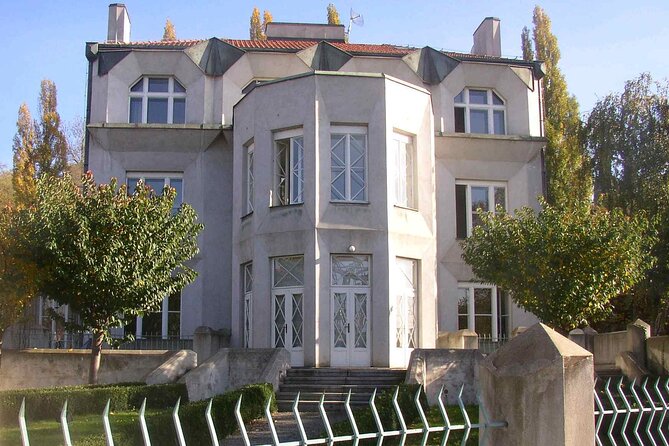
Prague’s Art Nouveau and Cubist architecture tells a different story from the city’s Gothic towers and Baroque churches. This private walk shows you the Prague that looked forward, with curving signs, floral details, daring geometry, grand cafés, and buildings shaped by Czech confidence at the turn of the 20th century.
I like the private format, since you can ask about details that would vanish in a large group. I also like the clear arc through the city, from the Cubist House of the Black Madonna to the Art Nouveau interiors around Wenceslas Square and Lucerna. The drawback is simple: three hours on foot is a lot, and the pace may not suit anyone with limited mobility.
Key details before you book
- A private guide for up to 10 people: Your group gets the historian’s full attention, with no strangers joining the walk.
- Nine major stops in about three hours: The route covers architecture, interiors, public squares, railway design, and a modern sculpture.
- Two striking styles in one walk: You’ll compare Art Nouveau’s flowing lines with Cubism’s sharp, broken forms.
- Guides bring different strengths: Bonita connects art, culture, and history, while Robert Wesley adds personal stories to the buildings.
- Walking is the main activity: Wear comfortable shoes and expect a substantial city walk rather than a stop-and-go sightseeing bus tour.
Why Prague’s modern architecture deserves your time
Most first visits to Prague focus on the medieval center. That makes sense, but it can also leave you with a narrow picture of the city. The years around 1900 brought new confidence, new technology, new businesses, and new ideas about how a modern European capital should look.
Art Nouveau was part of that change. It favored natural shapes, flowing lines, flowers, leaves, decorative lettering, patterned glass, and elaborate interiors. On this walk, you learn to look for details such as gingko biloba leaves, which point to the style’s interest in Asian and other non-European influences.
Cubism is more angular and forceful. Instead of soft curves, it uses sharp planes, geometric forms, and faceted surfaces. Prague’s version is especially interesting because it applied Cubist ideas to buildings, furniture, and interiors rather than leaving them only to paintings.
I would take this tour early in a Prague visit if architecture interests you. Once your guide points out the shapes and motifs, you’ll notice them elsewhere in the city. The tour changes the way you read façades, signs, bank buildings, arcades, and public spaces.
More walking routes in Prague:
- Prague: 3-Hour Walking Tour of Old Town & Prague Castle
★ 4.7 · 5,696 reviews - Prague: Ghost Walking Tour Where Legends Come To Life
★ 4.4 · 5,253 reviews - Prague: Jewish Quarter Walking Tour with Admission Tickets
★ 4.7 · 3,729 reviews
Starting at the House of the Black Madonna
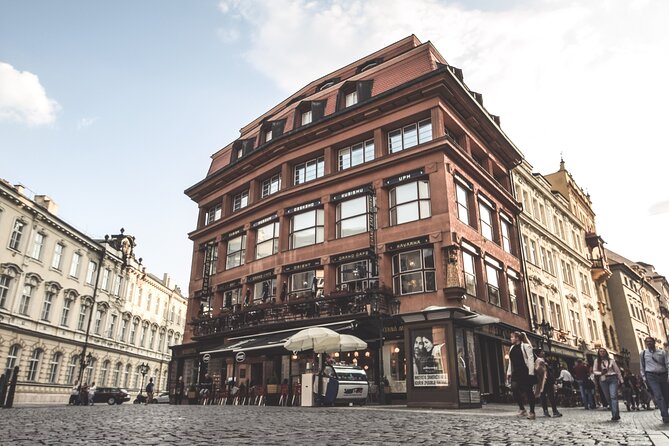
The walk begins at the House of the Black Madonna, one of Prague’s best-known Cubist buildings. Its name refers to the black Madonna sculpture on the building, while its design shows how sharply Czech architects adapted Cubist ideas for city life.
The building is a useful opening lesson because it does not look like a painting translated into stone. Its structure, angles, and decorative elements make you think about how a commercial building could take on an avant-garde shape without losing its practical purpose.
You’ll spend about 10 minutes here. That is enough for an introduction and a close look, but not enough for a long interior visit. The attraction is the building itself and the way your guide explains its design.
Obecni Dum and the confidence of Czech Art Nouveau
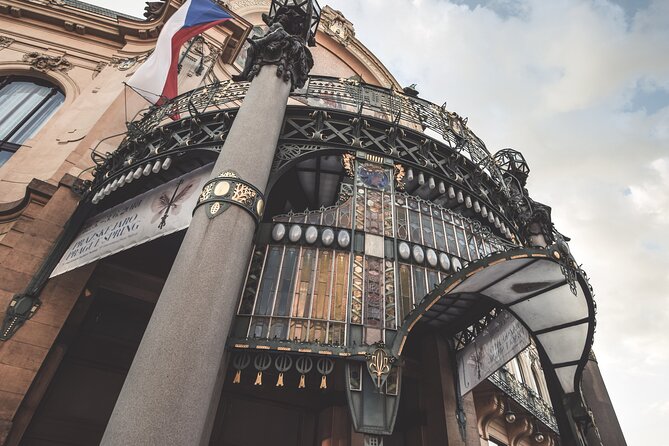
Obecni Dum, or the Municipal House, is one of the major Art Nouveau landmarks on the route. Its decoration shows the style at full scale, with ornamental surfaces and an architectural program that feels tied to public life and national pride.
Your guide can help you move past the broad impression of beauty and identify the elements that make the building Art Nouveau. Look for curves, plant forms, decorative lettering, and the way interior and exterior design work together.
The planned stop lasts about 15 minutes. You should not expect a full concert-hall or museum visit during this walking tour. Instead, you get a focused explanation of why the building matters and how it fits Prague’s cultural ambitions around 1900.
K+K Hotel Central and the beginning of a new era
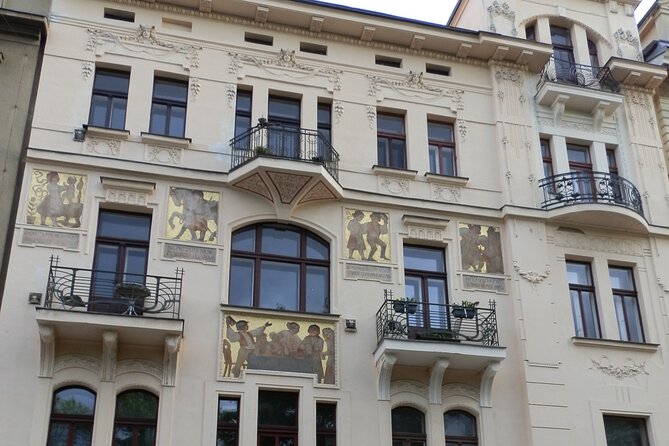
K+K Hotel Central Prague is presented as the first Art Nouveau building in Prague. That claim gives this stop special weight, since it lets you consider the style at its early stage rather than only through its most extravagant examples.
A hotel is also a useful subject. Unlike a church or civic hall, it was made for modern urban life, business, tourism, and social movement. The building helps connect architecture with the changing role of Prague as a city ready to participate in wider European trends.
The stop is about 10 minutes. You’ll mainly study the exterior and hear the historical context, so keep your expectations realistic if you are hoping to tour the hotel’s full interior.
A few more things to do in Prague worth a look
- Prague Old Town: Private Tour
★ 5.0 · 1,223 reviews - Prague Airport Private Arrival Transfer
★ 4.5 · 991 reviews - Prague Airport Private Departure Transfer
★ 4.5 · 780 reviews - Discover Prague Private Tour – 3 hours
★ 5.0 · 705 reviews
A brief look inside Café Imperial
Café Imperial offers a short but appealing pause in the route. Its Art Nouveau interior shows how decorative design moved into everyday social spaces, not just grand public buildings.
You’ll have around five minutes here. That makes this more of a visual stop than a meal break. Food and drinks are not included, so you should not count on sitting down for coffee during the scheduled tour.
Still, the stop matters because cafés were part of the new urban culture. They were places to meet, read, discuss politics, and take part in the public life of a changing city. The interior gives you a sense of how design shaped that experience.
The Czechoslovak Legion Bank’s angular message
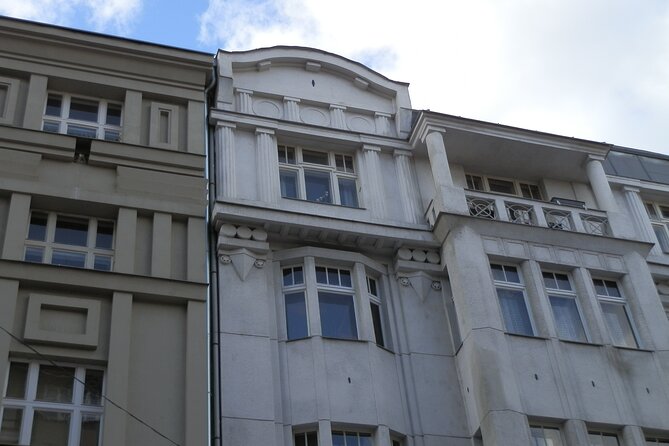
The Czechoslovak Legion Bank brings you back to Cubism, but with a different mood from the House of the Black Madonna. Its architecture and interior are dedicated to the Czechoslovak Legion of the First World War, adding national memory to the geometric design.
This is one of the more useful stops for understanding that architecture is not only about decoration. A bank can express ideas about the nation, its citizens, and its future. Here, the sharp Cubist forms work alongside a political and historical purpose.
The planned visit lasts about 10 minutes. Your guide’s explanation is important, since the building’s meaning may not be obvious from a quick look at its angles and façade.
Prague Main Train Station’s Art Nouveau dome
Prague Main Train Station gives the tour a change of scale. Railway stations were symbols of movement, technology, and modern city life, and this station’s Art Nouveau dome offers a grand interior contrast to the more compact buildings seen earlier.
You’ll spend about 15 minutes here. The station is still a working transport hub, so the experience is not a quiet museum visit. You’ll be looking at the historic interior while ordinary city traffic continues around you.
I like this stop because it links style with function. Art Nouveau was not only used for elegant cafés and hotels. It also shaped places where people arrived, departed, worked, and encountered the city for the first time.
Wenceslas Square and two styles in one urban space
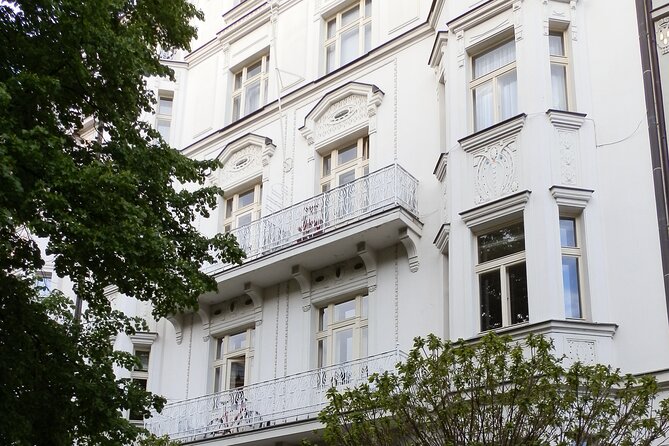
Wenceslas Square is a broad public setting where the guide discusses both Art Nouveau and Art Deco architecture. The square lets you compare two related but different approaches to modern design.
Art Nouveau favors organic decoration and flowing lines. Art Deco, which followed later, tends toward cleaner geometry, symmetry, and a more streamlined sense of luxury. Seeing both around the same square gives you a practical way to tell them apart.
The stop lasts about 15 minutes. This is also where the tour’s social and political context becomes easier to picture. The buildings are not isolated works of art. They face a major public space, so they help show how Prague presented itself as a modern capital.
Lucerna Arcade and the city’s social interiors
Lucerna Arcade is one of the most enjoyable parts of the route for anyone who likes interiors. Its Art Nouveau design gives you a closer look at the decorative spaces people moved through in daily life.
The arcade is also connected with the Lucerna Bar, once owned by Vaclav Havel’s family. That detail adds a personal and political layer to the architecture. You are not only studying ornament. You are also considering the people and families who shaped Prague’s cultural life.
You’ll spend about 10 minutes here. The stop is short, so your guide’s eye is useful. Ask about the lighting, signs, surfaces, and decorative patterns that you might otherwise pass without noticing.
The upside-down Wenceslas statue
The final stop is David Cerny’s upside-down statue of King Wenceslas riding a dead horse. It is a contemporary work, but the guide uses it to discuss Czech history, symbolism, and the Czech National Revival.
This is a smart ending because it moves the tour from historic architecture into modern commentary. After several hours of studying buildings that express optimism and national identity, you get a sculpture that questions those same ideas.
The planned stop lasts about 10 minutes. You’ll have time to consider the image and hear how it relates to Czech history, but this is not a separate modern-art tour. Its value comes from the connection your guide makes between older national symbols and newer forms of expression.
What the private format adds
The tour costs $396.46 per group of up to 10 people. That is a serious price for a three-hour walk if you are booking alone or with only one companion. For a full group, however, the cost becomes much easier to justify because it works out to roughly $39.65 per person at ten people, before any booking fees or changes in displayed pricing.
The main value is not admission. The listed stops are free, and food and drinks are not included. You are paying for the historian guide, the route, the explanations, and the chance to shape the conversation around your own interests.
A private guide can slow down for a façade, explain a detail twice, or answer a question about Czech history without holding up 30 other people. The experience also avoids the generic city-tour problem of rushing past buildings with only a name and date.
The quality depends partly on the guide you receive. Robert Wesley has been praised for combining building-by-building explanations with personal stories, including his Czech background and Nigerian father. Bonita brings together art, culture, architecture, and history in a way that suits readers who want more than a list of styles.
Timing, meeting point, and walking demands
You can choose a morning or afternoon departure. Unless hotel pickup is arranged, meet your guide 15 minutes early at Grand Cafe Orient, Ovocný trh 19 in Prague 1.
Pickup is offered, but hotel pickup and drop-off are not included unless arranged. Confirm that detail before booking if you want the tour to begin at your accommodation.
The route includes about 100 minutes of scheduled time at the nine stops, leaving the rest of the three-hour period for walking and transitions. That means the total distance and pace matter. One direct account describes the walk as unsuitable for people with mobility limitations, so I would not choose it if long periods on foot are a concern.
Wear supportive shoes. You may also want to schedule a break afterward rather than placing another demanding walking activity immediately after this one.
Who should book this Prague walk
I would recommend it to:
- First-time Prague visitors who want to look beyond medieval landmarks
- Architecture students and design fans
- Couples or families who prefer a private guide
- Small groups splitting the cost
- Anyone interested in Czech national identity and modern European culture
- People who enjoy learning how to spot visual details for themselves
I would be more cautious if you want extensive interior access, a relaxed café stop, or a tour with very little walking. The schedule gives you focused visits, not long museum sessions. Café Imperial and the other interiors are viewed within the flow of a walking route, and food is not part of the experience.
The English-language format is useful for international visitors, while the mobile ticket and public-transport access make the tour easy to fit into a Prague itinerary. Confirmation arrives at booking, and cancellation is free up to 24 hours before the start time. Last-minute changes or cancellations do not qualify for a refund.
Should you book it?
Book this tour if you want Prague’s Art Nouveau and Cubist buildings explained by a historian rather than simply photographed from the pavement. The strongest reasons are the private format, the range of stops, and the way the route connects architecture with Czech culture and national memory.
Skip it if you dislike walking, need guaranteed extended indoor visits, or cannot make the group price work. For a group of several people, the cost is much more reasonable, and the tour can become one of the more useful three-hour introductions to Prague’s modern side.
FAQ
How long is the Prague Art Nouveau and Cubism walking tour?
The tour lasts approximately three hours.
How many people can join the private tour?
The price covers a private group of up to 10 people.
What language is the tour offered in?
The tour is offered in English.
Where does the tour begin?
Unless hotel pickup has been arranged, meet the guide 15 minutes before the start at Grand Cafe Orient, Ovocný trh 19, Prague 1.
Are food and drinks included?
No. Food and drinks are not included unless specifically stated.
Can I cancel for a full refund?
Yes. You can cancel at least 24 hours before the local start time for a full refund. Cancellations or changes made less than 24 hours before the start time are not accepted for a refund.
Just added in Prague
- World War II 4WD Tour from Prague with Lunch★ 4.4 · 3 reviews
- Prague: Historical Walking Tour with Focus on World War 2★ 4.3 · 12 reviews
- WWII and Communism History in Prague’s Old Town Private Tour★ 5.0 · 4 reviews
- Unique salt cave in Prague★ 4.9 · 10 reviews
- Walking tour of Prague in french: Old Town & Charles Bridge★ 4.9 · 62 reviews
- Prague: Market Tour and Traditional Czech Cooking Class★ 4.7 · 19 reviews
- Ultimate Unlimited Beer Pong with Czech Beer★ 4.6 · 5 reviews
- Walking tour of Prague in French : Nové Město★ 4.9 · 16 reviews
Walking Tours, compared.
3-Hour Walking Tour of Old Town & Prague Castle
Read our review →
Ghost Walking Tour Where Legends Come To Life
Read our review →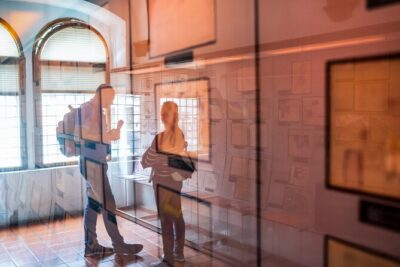
Jewish Quarter Walking Tour with Admission Tickets
Read our review →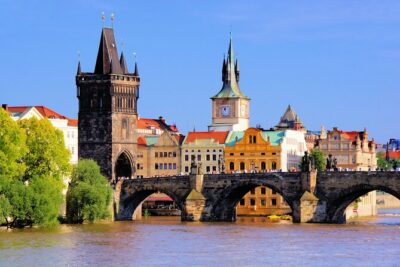
Prague Guided Walking Tour and Cruise with Authentic Czech Lunch
Read our review →
Old Town and Jewish Quarter Guided Walking Tour
Read our review →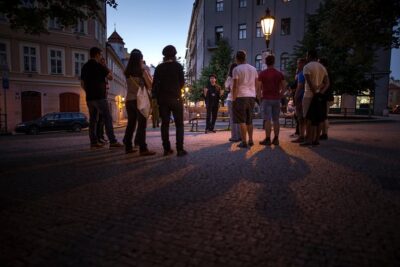
Prague Ghost and Legend of Old Town Walking Tour
Read our review →
Prague 3-hour Afternoon Walking Tour including Prague Castle
Read our review →
Ghosts and Legends Nighttime Guided Walking Tour
Read our review →Browse the lists this tour appears in