Reviewed · TOURS IN PRAGUE
Back In Time: Zážitkové muzeum historie
Prague’s Back In Time museum turns history into a short, hands-on show. You move through scenes from the Middle Ages, Renaissance, and later Czech history, then finish with a 5D cinema built to add motion, sound, and a jolt of adrenaline. It is less a quiet museum than a fast introduction to the city’s biggest stories.
I like two things right away. The time machine and authentic scenes give children a reason to pay attention, while the selection of subjects gives you useful context before you explore Prague on foot. I also like the clear one-hour format, which fits neatly between sightseeing stops.
The main consideration is depth. At $18 per person, this is a reasonable family attraction, but one hour leaves limited space for detailed history. If you want long explanations, original objects, or careful historical debate, you may find the storytelling light.
Key points at a glance
- A one-hour route through Prague’s past: The visit covers Libuše, the Golem, Charles IV, the Astronomical Clock, and the Prague Uprising.
- Interactive history for children: Modern technology and staged scenes make major events easier for younger visitors to follow.
- A 5D cinema finale: Expect the most energetic part of the experience here, with the screen designed to feel more physical and immediate.
- A useful first stop in Prague: The museum can give you names, legends, and events to look for during later walks around the city.
- A family and school-friendly format: The mix of entertainment and teaching works best for children at least six years old and taller than 110 centimeters.
- Good value with limits: The price is modest for an indoor activity, but the short visit is designed as an introduction, not a full history course.
A quick route through Prague’s story
Back In Time Prague is built around a simple idea: history is easier to remember when you can see it, hear it, and take part in it. Instead of walking through rows of display cases, you pass through themed areas that use scenes and technology to present important moments.
The route includes the founding of Prague by Libuše, the legend of the Golem, the world of King Charles IV, the creation of the Astronomical Clock, and the Prague Uprising. These subjects span legend, medieval power, science, civic identity, and modern conflict.
That range is useful. You will not leave with a full timeline of Czech history, but you will gain several reference points. Later, when you see Charles Bridge, the Old Town Hall, or the Jewish Quarter, the names and stories should feel less disconnected.
The format is also easy to manage. The listed duration is one hour, so you do not need to give up half a day. I would place it early in a Prague visit, especially if you are arriving with children who need a lively introduction before more traditional museums and walking tours.
Other trips people book in Prague:
- Prague: 50-Minute Sightseeing Evening Cruise
★ 4.2 · 33,780 reviews - Prague: Medieval Dinner with Unlimited Drinks
★ 4.4 · 19,847 reviews - Prague: Skip-the-line Castle Ticket and Optional AudioGuide
★ 4.3 · 11,121 reviews
Libuše and the founding of Prague
The story of Libuše presents Prague through one of its best-known origin legends. In the experience, this early chapter helps frame the city not simply as a collection of old buildings, but as a place with stories about prophecy, power, and beginnings.
For children, a legendary founder is often easier to remember than a list of dates. For adults, it offers a useful reminder that Prague’s identity is built from both documented history and old tales passed down through generations.
Do not expect this part to function like an academic lecture. The museum is designed for quick understanding and visual impact. You may get the main idea rather than every version of the legend or a careful explanation of what historians can prove.
That is not necessarily a flaw. If you use the scene as a starting point, you can later ask more questions while visiting Prague Castle, Old Town, or other historic areas. The attraction gives you a story to carry into the city.
The Golem and Prague’s Jewish legends
The Golem is one of Prague’s most famous legends, linked in popular culture with the Jewish Quarter and Rabbi Loew. Its inclusion makes sense because it connects local folklore with one of the city’s most visited historic districts.
This is a strong subject for an interactive attraction. The Golem story has a clear sense of mystery and drama, so it can hold a child’s attention better than a dry account of dates and rulers. It also gives families a reason to learn more about the history of Prague’s Jewish community after leaving the museum.
The important distinction is that a legend is not the same as a documented event. You should treat this section as cultural storytelling rather than proof that the creature existed. That balance matters, particularly if you are using the visit as part of a school lesson.
The museum’s strength here is its ability to make a familiar Prague symbol memorable. Its weakness is the same as elsewhere in the attraction: a short presentation may not provide much background beyond the central tale.
Charles IV beyond the postcard image
Charles IV is one of the key figures in Prague’s medieval story, and the experience promises a look at what his real life was like. That wording suggests a human angle rather than only a list of buildings connected with his reign.
This is valuable because visitors often know Charles IV mainly through landmarks. Charles Bridge carries his name, and his period shaped Prague’s importance, but a city walk does not always explain the person behind the monuments.
You may find this section helpful before exploring the bridge, the Old Town, or Prague Castle. It gives you a reason to connect architecture with political ambition, royal life, and the growth of the city.
Again, keep your expectations in check. The one-hour visit covers several subjects, so the Charles IV section cannot offer the same detail as a dedicated historical tour. Think of it as a prompt for further exploration rather than the final word on his life.
Same streets, a different kind of outing:
- Prague: Castle Tour with Local Guide and Entry Ticket
★ 4.6 · 10,422 reviews - Prague Castle 2.5-Hour Tour Including Admission Ticket
★ 4.7 · 8,927 reviews - Prague: Oldtown, Medieval Underground & Dungeon History Tour
★ 4.2 · 8,244 reviews - Prague: Vltava River Night Cruise with Buffet
★ 4.3 · 7,338 reviews
The Astronomical Clock and its real story
The Astronomical Clock is one of Prague’s most popular sights, yet many visitors watch the figures move without understanding how the clock fits into the city’s history. Back In Time includes the founding of the clock and what is described as its real story.
That focus gives the museum a practical role. After the visit, you can look at the clock in Old Town Square with more purpose. You may pay attention not just to the hourly display, but also to the idea of engineering, civic pride, and the long life of a public landmark.
The word real is useful here because the clock has attracted plenty of dramatic stories over the years. The attraction appears to separate the popular tale from the historical account, though the supplied information does not give enough detail to say exactly how far that explanation goes.
For families, this is one of the easiest sections to extend into a city outing. See the museum first, then visit the actual clock. The connection between the indoor scene and the real building can help children understand that Prague’s history is still visible in the streets.
The Prague Uprising and the later past
The Prague Uprising brings the story into the modern period. Its inclusion prevents the attraction from treating Prague as only a medieval or Renaissance city.
That wider time span matters. Prague’s identity was shaped not only by kings, legends, and old buildings, but also by conflict and civic resistance. Including the uprising gives schools and families a chance to discuss how the city changed during a difficult period.
This may also be the point where the experience feels less like a fairy tale. Younger children may understand the broad idea of an uprising, but adults may want more context about the event, its causes, and its consequences. The museum’s short format limits how much can be explained.
If you are visiting with school-age children, use this section as a conversation starter. Ask what makes an event important to a city, and how public memory changes over time. The attraction provides the prompt, while your later sightseeing can supply the wider setting.
What the time machine adds
The time machine is one of the central features of the visit. Rather than simply reading that Prague changed across centuries, you are given a device or presentation built around the idea of moving between periods.
This helps organize the experience. The Middle Ages, Renaissance, and later eras can blur together when you are seeing historic buildings in quick succession. A time-travel structure gives the visit a clear rhythm and makes the change between periods easier to grasp.
It also keeps the museum from feeling like a standard classroom. That is especially useful for families with children who may have limited patience for long text panels. You can expect a show built around movement, atmosphere, and short bursts of information.
The trade-off is that spectacle can take space away from explanation. If you prefer quiet galleries and detailed labels, the time machine format may feel too brisk. If you want a memorable introduction before walking around Prague, it is likely to work better.
The 5D cinema is the adrenaline stop
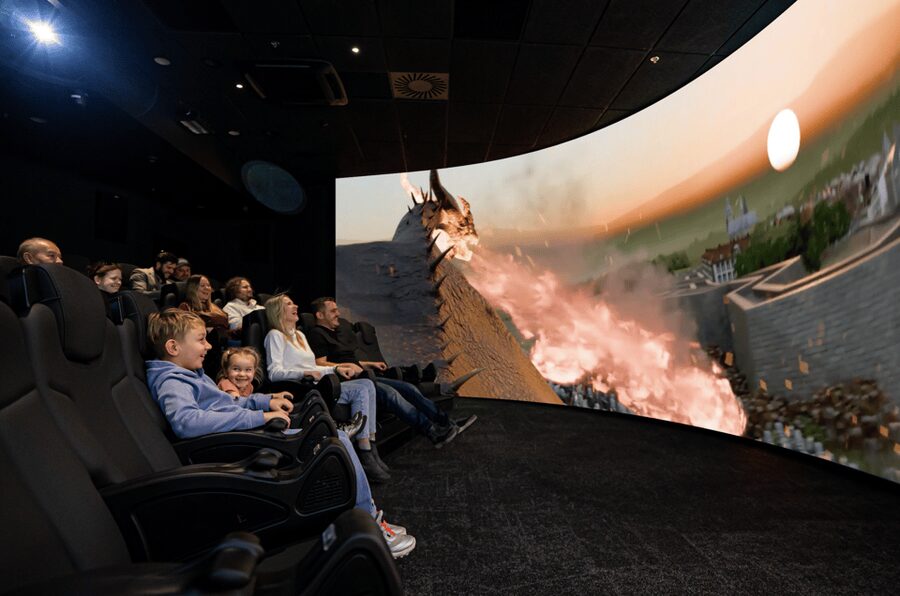
The 5D cinema is designed as the most physical part of the visit. The description promises a screen that comes to life and a good dose of adrenaline, so you should expect effects and presentation rather than a conventional historical film.
This is likely to be the highlight for many children. It breaks up the historical scenes and gives the one-hour visit a clear entertainment peak. It also explains why the attraction may appeal to families who would not choose a traditional museum.
There is an important safety point. Entry is not permitted for people with epilepsy, claustrophobia, or heart disease, and pregnant women are listed as unsuitable for the experience. Children must be at least six years old and taller than 110 centimeters, which is just under 3 feet 8 inches.
Take those limits seriously. The 5D element is not an optional detail in the way a small video might be. The safety guidance indicates that the effects may be physically or visually demanding. If anyone in your group has a relevant condition, choose another activity rather than trying to push through.
How much history do you get for $18?
At $18 per person, the experience is priced like a compact attraction rather than a full museum day. The value depends on what you want from it.
For a family, I can see the appeal. You get an indoor activity lasting about an hour, several major Prague themes, interactive exhibits, a time machine, and a 5D cinema. The format may also save parents from trying to keep children engaged through a long museum visit.
For a school group, the price can make sense if the visit supports a wider lesson about Prague or Czech culture. The material touches on legends, rulers, technology, civic history, and conflict. Teachers should add their own explanation, since the attraction is not designed to replace a full history class.
For an adult who already knows Prague well, the value is less certain. You may enjoy the effects and the chance to see familiar subjects presented in a different way, but the content may feel brief. One available Polish-language rating praised the organization but found the historical storytelling weak and the amount of content limited. That is a fair warning for serious history enthusiasts.
The strong overall rating of 4.9 from 27 ratings, along with specific praise for children, points to the attraction’s main strength: it is an entertaining introduction. Book it for access, atmosphere, and family time, not for exhaustive research.
Who should visit, and who should skip it
I would recommend Back In Time Prague most strongly to families with children six and older who are at least 110 centimeters tall. It is also a good fit for first-time visitors who want basic context before seeing Prague’s main sights.
Schools can use it well when the visit is paired with discussion or a later city walk. The subjects are broad enough to support lessons about legends, medieval rule, architecture, public memory, and modern conflict.
Adults who enjoy interactive attractions may also have fun, especially if they want something different from churches, galleries, and walking tours. The one-hour length makes it easy to add to a busy day.
I would skip it if you are looking for original artifacts, long historical explanations, or a quiet museum experience. I would also skip it if you are pregnant, have epilepsy, claustrophobia, or heart disease. The attraction is not suitable for children under six or anyone under 110 centimeters.
The venue is wheelchair accessible, which makes it easier to consider for mixed groups. The supplied information does not explain every detail of the accessible route, so you may want to confirm specific needs when booking.
Planning the visit around Prague sightseeing
The museum works best as an early orientation stop. Afterward, you can connect the stories to real places in the city: look for Charles IV’s mark on the historic center, visit the Astronomical Clock, and explore the area associated with the Golem legend.
You can also place it on a rainy day or during a short gap between larger activities. Since the visit lasts one hour, it does not demand the planning required by a half-day tour.
Flexible booking adds practical value. You can reserve now and pay later, and cancellation is allowed up to 24 hours before the activity for a full refund. Those terms are useful when your Prague schedule depends on weather, children’s energy, or changing arrival plans.
There is no guide name provided for this experience, and the format appears to rely on exhibits, scenes, technology, and cinema rather than a named live guide. That means you should not book it expecting a personal walking tour or a long question-and-answer session.
Should you book Back In Time Prague?
Book it if you want a lively, compact introduction to Prague that children can follow. The best reasons are the clear one-hour format, the mix of Czech legends and major historical figures, and the 5D cinema that adds energy to the visit.
I would be more cautious if your main goal is detailed history. The broad range of topics means each one receives limited time, and the available feedback includes a clear concern about light storytelling and limited content.
My practical advice is simple: families, school groups, and first-time visitors should consider it, especially on a rainy day or at the start of a Prague stay. History specialists and adults seeking a serious museum should spend the $18 elsewhere. Used as a lively starting point, Back In Time Prague can help you notice more when you step back into the real city.
FAQ
Where is Back In Time Prague located?
The experience is located in Prague, in the Central Bohemian Region of the Czech Republic.
How long does the experience last?
The stated duration is one hour.
How much does admission cost?
The listed price is $18 per person.
What historical periods are included?
The experience covers the Middle Ages, the Renaissance, and other important periods of Czech history.
Which Prague stories and events are included?
The visit includes the founding of Prague by Libuše, the legend of the Golem, the life of King Charles IV, the founding of the Astronomical Clock, and the Prague Uprising.
Is there a 5D cinema?
Yes. A 5D cinema experience is included.
Is there a time machine?
Yes. The time machine is included among the interactive parts of the experience.
What is the minimum age?
Children must be at least six years old.
Is there a minimum height requirement?
Yes. Visitors must be taller than 110 centimeters, or about 3 feet 7 inches.
Is the experience wheelchair accessible?
Yes. The activity is listed as wheelchair accessible.
Just added in Prague
- World War II 4WD Tour from Prague with Lunch★ 4.4 · 3 reviews
- WWII and Communism History in Prague’s Old Town Private Tour★ 5.0 · 4 reviews
- Prague: Historical Walking Tour with Focus on World War 2★ 4.3 · 12 reviews
- Unique salt cave in Prague★ 4.9 · 10 reviews
- Walking tour of Prague in french: Old Town & Charles Bridge★ 4.9 · 62 reviews
- Prague: Market Tour and Traditional Czech Cooking Class★ 4.7 · 19 reviews
- Ultimate Unlimited Beer Pong with Czech Beer★ 4.6 · 5 reviews
- Walking tour of Prague in French : Nové Město★ 4.9 · 16 reviews
Tours in Prague, compared.
Castle Tour with Local Guide and Entry Ticket
Read our review →
Prague Castle 2.5-Hour Tour Including Admission Ticket
Read our review →
Oldtown, Medieval Underground & Dungeon History Tour
Read our review →