
Reviewed · WALKING TOURS
Prague Renaissance & Baroque Gardens Walking Tour
Prague’s best garden tour is not really about flowers. It is about power told through statues, fountains, plants, and views. In three hours, you move from the Renaissance gardens of Prague Castle to Wallenstein’s theatrical Baroque grounds, ending at the steep terraces of Vrtba Garden.
I like the small maximum of eight people, which gives the guide room to answer questions and adjust the talk to your interests. I also like the unusual details: the first central European fig and citrus growing, tulips arriving in Prague, and Greek and Roman gods used to send political messages. The main drawback is price. At $126.03 per person, this is not a casual stroll, and you still pay separate admission to Vrtba Garden and the Prague Castle gardens.
Key points to know before booking
- Small group of up to eight: You get direct access to the guide rather than a speech delivered to a crowd.
- Three very different garden styles: See Renaissance order at Prague Castle, Italian-inspired Baroque design at Wallenstein Garden, and Vrtba’s compact hillside terraces.
- Bonita and Vadim bring the art to life: Their approach connects statues and myths with the political ambitions of Prague’s rulers.
- The 22 tram is part of the route: Your group rides together from Malostranská toward Prague Castle.
- Vrtba Garden costs extra: Budget CZK 130 for an adult or CZK 100 for a student or senior.
- Steep stairs at the final garden: You can wait on the second terrace if reaching the top is difficult.
Why Prague’s gardens deserve a full tour
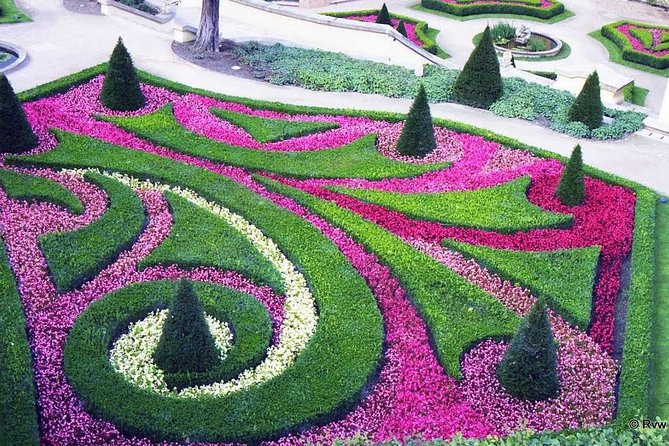
Prague’s famous sights can make the city seem like one long procession of churches, towers, and palace facades. The gardens give you a quieter way to understand the same city. Here, architecture continues outdoors, and every carefully placed statue or framed view has a purpose.
The walk focuses on Renaissance and Baroque design. Renaissance gardens favor balance, geometry, useful plants, and classical ideas drawn from Italy and antiquity. Baroque gardens are more theatrical. They use surprise, movement, sculpture, water, and forced perspective to make a noble residence feel grander than it really is.
That distinction matters. You will not simply hear the names of old gardens and pass through them. You will learn why a fountain sits where it does, why mythological figures appear beside a palace, and how a garden could advertise the education, wealth, and political reach of its owner.
The guides, especially Bonita and Vadim, bring an art-history angle that makes this more than a standard city walk. Bonita is particularly associated with stories about Greek and Roman mythology, and that material gives the statues a second life. A figure that first looks decorative can become a carefully chosen political statement.
More walking routes in Prague:
- Prague: 3-Hour Walking Tour of Old Town & Prague Castle
★ 4.7 · 5,696 reviews - Prague: Ghost Walking Tour Where Legends Come To Life
★ 4.4 · 5,253 reviews - Prague: Jewish Quarter Walking Tour with Admission Tickets
★ 4.7 · 3,729 reviews
Starting at Malostranská and riding tram 22
The meeting point is Bagel Lounge Malostranská at Letenská 118/1, close to Malostranská Metro station. This is a practical place to meet because the station is well connected and the route begins with a shared ride on tram 22.
The tram ride matters for two reasons. First, it saves you from starting with a long uphill walk. Second, it links the gardens naturally to Prague Castle, rather than treating each site as a disconnected stop. Your group rides together, and the guide can begin setting up the story of the castle district before you reach the gardens.
The tour is offered at 10 a.m. and 2 p.m. The morning departure gives you more time afterward for the castle interiors, Lesser Town, or a leisurely lunch. The afternoon option works well if you want to visit another sight first, though the gardens may be the last major activity of your day.
Wear shoes with a firm sole. This is not a difficult hike, but it is a walking tour with stairs, inclines, and uneven historic surfaces. The steepest section comes at Vrtba Garden.
Queen Anne’s Summer Palace and the Royal Garden
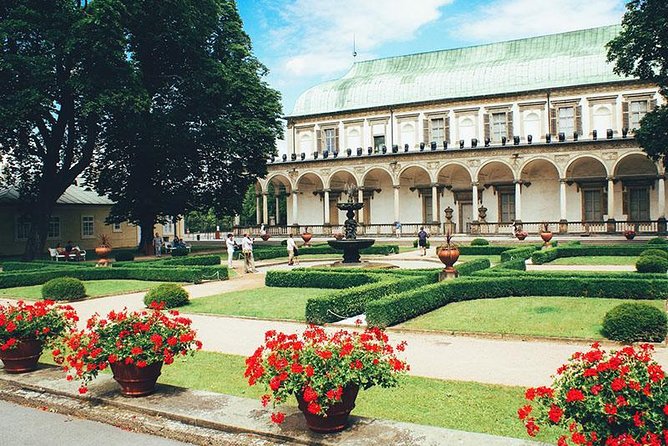
The first major section takes you through the Royal Garden beside Prague Castle. The garden was created in the 1500s on the site of medieval vineyards and later became known for unusual plants brought from distant places.
One of the most interesting details here is the garden’s early role in growing plants unfamiliar to central Europe. The Fig House and Orangery are tied to the cultivation of figs, almonds, oranges, and lemons. That is a useful reminder that royal gardens were not only pretty parks. They were places for experiment, display, and controlled access to rare plants.
You also hear how tulips first reached Prague. The detail may seem small, but it helps you picture the garden as a place connected to trade, travel, and courtly fashion. A plant could be as much a status symbol as a painting or a piece of jewelry.
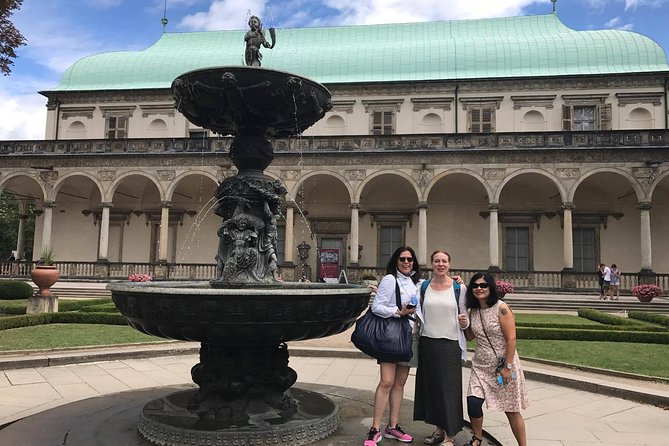
The centerpiece is Queen Anne’s Summer Palace, also called the Belvedere. It was finished in the middle of the 16th century and is considered one of the purest examples of Renaissance architecture outside Italy. Its arcades, Tuscan capitals, and ornamental frieze reward a slow look.
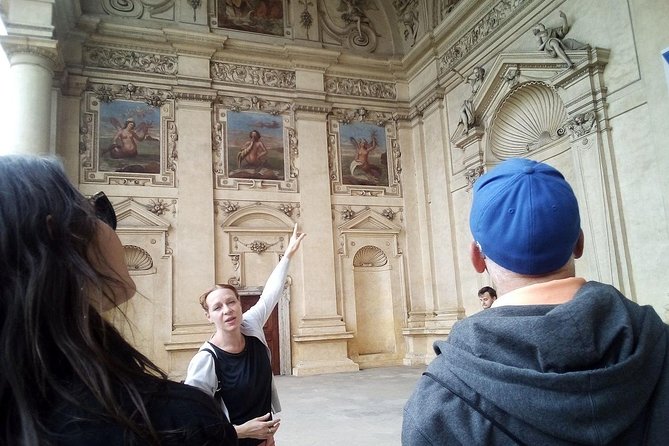
The decoration is not random. Reliefs show mythology, hunting, and warfare. One scene includes Ferdinand I wearing the Order of the Golden Fleece and presenting a fig blossom to his wife, Queen Anna. A guide can turn those carved details into a readable story rather than leaving you to guess at the meaning.
The palace itself receives only a short formal stop, but the surrounding Royal Garden gives the building room to make sense. You see how the clean lines of Renaissance architecture work with paths, planting, and open space. This is a photographic part of the tour, but it is also one of the strongest sections for understanding how Prague adopted ideas from Italy.
The Ball Game Hall above the Stag Moat
The Ball Game Hall sits on the south side of the Royal Garden, directly above the Stag Moat. Built in the middle of the 1500s, it was designed for ball games and later served as a riding school and stables.
You may spend only about five minutes here, so do not expect an extended interior visit. The value is in the building’s place within the castle complex. It shows how royal grounds combined formal gardens, recreation, animals, military concerns, and ceremonial architecture.
This quick stop also keeps the tour moving. The experience is not built around entering every palace or museum. It is about reading the outdoor spaces and seeing how the castle’s gardens supported court life.
Same streets, a different kind of outing:
- Prague: 50-Minute Sightseeing Evening Cruise
★ 4.2 · 33,780 reviews - Prague: Medieval Dinner with Unlimited Drinks
★ 4.4 · 19,847 reviews - Prague: Skip-the-line Castle Ticket and Optional AudioGuide
★ 4.3 · 11,121 reviews - Prague: Castle Tour with Local Guide and Entry Ticket
★ 4.6 · 10,422 reviews
Wallenstein Garden and Baroque theater
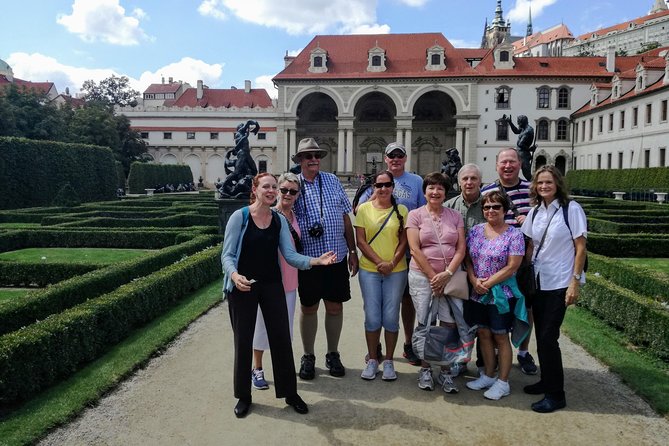
Wallenstein Garden brings a sharp change in mood. The Royal Garden feels measured and Renaissance in spirit. Wallenstein Garden is more dramatic, more crowded with symbols, and more eager to impress.
The garden was built in the 1600s for Wallenstein Palace and is now open to the public as the garden of the Czech Senate. Its Italian-style plan includes an aviary, an artificial grotto, a sculptural gallery of mythological heroes, and a fountain by Adrian de Vries.
This is where the guide’s attention to mythology pays off. The statues are not merely scattered ornaments. Their subjects reflect classical learning and the owner’s wish to present himself as powerful, cultured, and connected to the heroic world of antiquity.
The artificial grotto is especially effective because it breaks up the formal order of the garden. Baroque design often likes this kind of contrast: straight paths beside irregular rock, calm water beside theatrical sculpture, and carefully controlled nature made to look spontaneous.
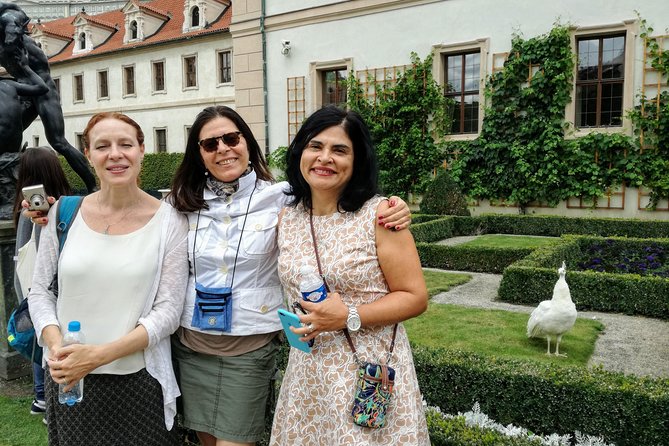
Peacocks add another layer of spectacle. They may be roaming the grounds, and their bright colors fit the setting almost too well. Still, do not make them the main reason to come. The garden’s real interest lies in the relationship between the palace, the statues, and the political messages built into the design.
Wallenstein Garden is open to the public, and admission is included. It can also provide a welcome pause from Prague’s busier streets. Even in the high season, the walled grounds can feel surprisingly calm.
Vrtba Garden, Prague’s compact Baroque showpiece
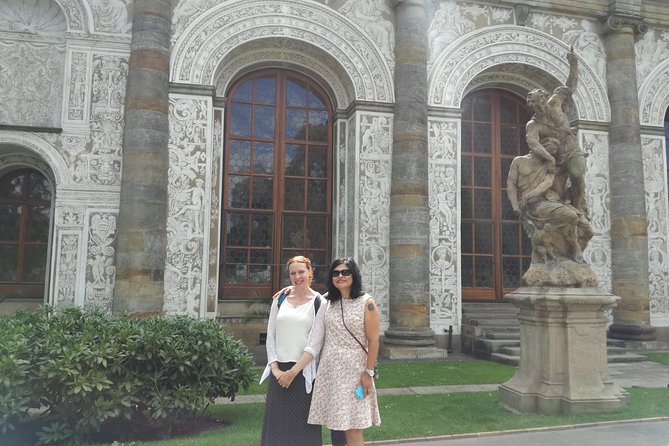
Vrtba Garden is the smallest major stop, but it may leave the strongest visual impression. Created around 1720, this walled Baroque garden rises in terraces on the side of Petřín Hill.
The garden’s design uses a tight site intelligently. Instead of spreading outward, it climbs upward. Stairs lead you through terraces decorated with original statuary and sculptural details, with Prague opening out below.
The top terrace offers views toward Prague Castle and the city. This is one of the tour’s best rewards because the view is not just a lookout point. You see the city from a garden built for private pleasure and noble display, looking across to the castle complex that shaped so much of Prague’s political life.
There is a practical catch. Vrtba Garden admission is not included. The adult fee is CZK 130, with a CZK 100 rate for students and seniors. Bring this extra cost into your budget before you book.
The stairs can be steep. If you have trouble climbing, you can wait on the second terrace while the rest of the group continues to the top, then rejoin the group about 10 minutes later. The garden is still worth seeing from below, but the upper terrace provides the clearest city views.
The supplied tour details give two different descriptions of the ending. One says the guide leaves you at Vrtba Garden, while the meeting information says the activity ends back at the starting point. Ask for confirmation when booking so you know if you need to plan your own return from Vrtba. This is a small but important point, especially if you have a timed dinner or evening performance.
How the guiding shapes the experience

The best part of this tour is the guide’s interpretation. Without explanation, a garden can become a pleasant walk with a few nice photo stops. With the right guide, it becomes a document of court life, ambition, religion, science, and classical education.
Bonita and Vadim are named as guides associated with the experience. Bonita’s stories about mythology are particularly useful at Wallenstein Garden and Vrtba Garden, where the sculptures carry much of the meaning.
The small group makes a real difference. With no more than eight people, you can ask why a statue was chosen, how a garden was used, or what a particular building once meant. The guide can also adjust the balance between architecture, botany, political history, and art depending on the group.
This is a tour for curious people who want context. If you prefer to move quickly, take photographs, and hear only a few headline facts, the detail may feel heavy. If you like learning why a place looks the way it does, the pace should suit you.
Price, timing, and overall value
At $126.03 per person, this is an expensive three-hour walking tour by Prague standards. You also pay CZK 130 for Vrtba Garden, and the Prague Castle gardens carry a separate admission charge of CZK 90 for adults or CZK 60 for students and seniors.
The value depends on how you use the tour. You are paying for a professional scholar guide, a maximum group size of eight, the shared tram route, and access to several gardens that are easy to overlook when exploring Prague alone. You are also getting interpretation that connects architecture, plants, sculpture, and political symbolism.
For a first visit, this can be a useful way to get beyond Prague’s most obvious sights. For someone who already knows the city, it offers a new angle. Local residents have found fresh material here, particularly in the stories behind familiar statues and garden spaces.
The price is harder to justify if you only want a general introduction to Prague. Other city walks may cover more landmarks for less money. This experience earns its cost only if you care about art, gardens, architecture, or the hidden meanings behind historic spaces.
The tour is offered in English and includes mobile ticketing. Confirmation arrives when you book, and free cancellation is available up to 24 hours before the start time. Changes or cancellations made inside that window are not accepted for a refund.
Who should book this garden walk?
I would choose this tour if you have already seen Prague’s main castle sights or want a quieter way to approach them. It is especially suitable for people who enjoy architecture, sculpture, garden design, botany, and stories about rulers and court culture.
It also works well for repeat visitors. Several of the stops are easy to pass without understanding their purpose, and the guide adds details that can change how you see the city afterward.
Families with older children may enjoy the peacocks, statues, palace stories, and tram ride. The steep stairs at Vrtba Garden are the main physical concern. Anyone who needs to avoid them should plan to wait on the second terrace or ask about a private version that can be modified for the group.
I would skip it if you dislike extended explanations or want a broad tour of Prague’s major buildings. This is a focused walk, not a greatest-hits tour.
Should you book the Prague gardens tour?
Book it if you want Prague’s outdoor spaces explained as art and political theater, not just admired as pretty gardens. The small group, strong guide focus, and unusual stops make it more personal than a large city tour.
Before paying, add the garden admission fees, confirm where the walk ends, and decide which departure time fits your day. If the price works for you and you can manage the stairs, this is a thoughtful, distinctive way to see Prague Castle and Lesser Town from a quieter angle.
FAQ
How long does the tour last?
The tour lasts approximately three hours.
Where does the tour begin?
You meet at Bagel Lounge Malostranská, Letenská 118/1, near Malostranská Metro station in Prague’s Malá Strana district.
What language is the tour offered in?
The tour is offered in English.
How many people are in the group?
The group has a maximum of eight participants.
Is transportation included?
The group takes tram 22 together from the Malostranská area to the Prague Castle gardens.
Is admission to Vrtba Garden included?
No. Vrtba Garden admission costs CZK 130 for an individual adult and CZK 100 for students and seniors.
Is admission to the Prague Castle gardens included?
No. The stated fee is CZK 90 for an individual adult and CZK 60 for students and seniors.
Are there steep stairs?
Yes. Vrtba Garden has steep stairs leading to its highest terrace. You can wait on the second terrace if climbing is difficult.
Are morning and afternoon departures available?
Yes. You can choose a 10 a.m. or 2 p.m. departure.
Can I cancel for a full refund?
Yes. You must cancel at least 24 hours before the experience begins to receive a full refund. Changes made less than 24 hours before the start are not accepted.
Just added in Prague
- World War II 4WD Tour from Prague with Lunch★ 4.4 · 3 reviews
- WWII and Communism History in Prague’s Old Town Private Tour★ 5.0 · 4 reviews
- Prague: Historical Walking Tour with Focus on World War 2★ 4.3 · 12 reviews
- Walking tour of Prague in french: Old Town & Charles Bridge★ 4.9 · 62 reviews
- Unique salt cave in Prague★ 4.9 · 10 reviews
- Prague: Market Tour and Traditional Czech Cooking Class★ 4.7 · 19 reviews
- Ultimate Unlimited Beer Pong with Czech Beer★ 4.6 · 5 reviews
- Walking tour of Prague in French : Nové Město★ 4.9 · 16 reviews
Walking Tours, compared.
3-Hour Walking Tour of Old Town & Prague Castle
Read our review →
Ghost Walking Tour Where Legends Come To Life
Read our review →
Jewish Quarter Walking Tour with Admission Tickets
Read our review →
Prague Guided Walking Tour and Cruise with Authentic Czech Lunch
Read our review →
Old Town and Jewish Quarter Guided Walking Tour
Read our review →
Prague Ghost and Legend of Old Town Walking Tour
Read our review →
Prague 3-hour Afternoon Walking Tour including Prague Castle
Read our review →
Ghosts and Legends Nighttime Guided Walking Tour
Read our review →Browse the lists this tour appears in