
Reviewed · COMMUNISM & WWII HISTORY TOURS
Private Prague Cold War Walking Tour
Prague’s Cold War story becomes most gripping when you see the machinery behind it: locked bomb-shelter doors, the former mausoleum of communist leader Klement Gottwald, and Wenceslas Square, where tanks once crushed reform and crowds later helped end communist rule. This private three-hour walk connects those places with the personal stories of life under a Soviet-controlled state.
I like the small-group format, which gives your guide room to explain political events, ask questions, and adjust the pace. I also like the view from Vitkov Hill and the chance to see places many first-time visitors miss, including the Red Army Hall and the old temperature-control rooms for Gottwald’s embalmed body.
The main drawback is physical: reaching the National Monument requires a steep climb of about 20 minutes. The tour also covers serious political material, so it suits curious history-minded people more than anyone seeking a light sightseeing stroll.
Key points before you book
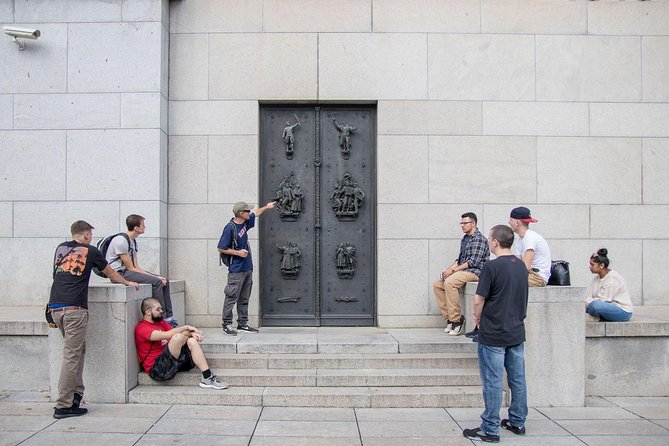
- Gottwald’s former mausoleum: See the laboratory and temperature-control area once used to preserve the body of Czechoslovak communist leader Klement Gottwald.
- A real Cold War walking route: Pass sealed doors linked to nuclear bomb-shelter corridors in the Karlin-Zizkov pedestrian tunnel.
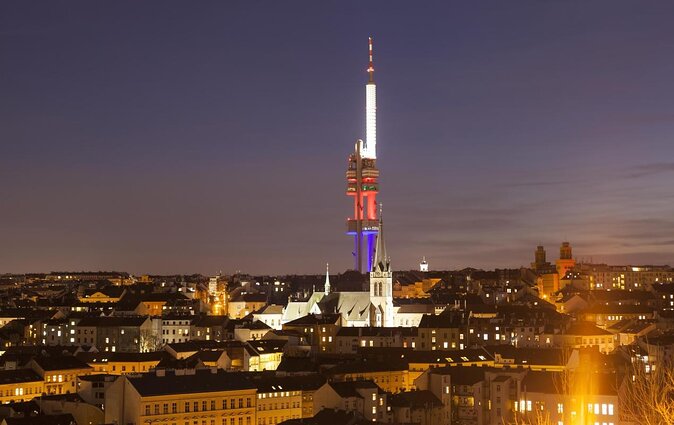
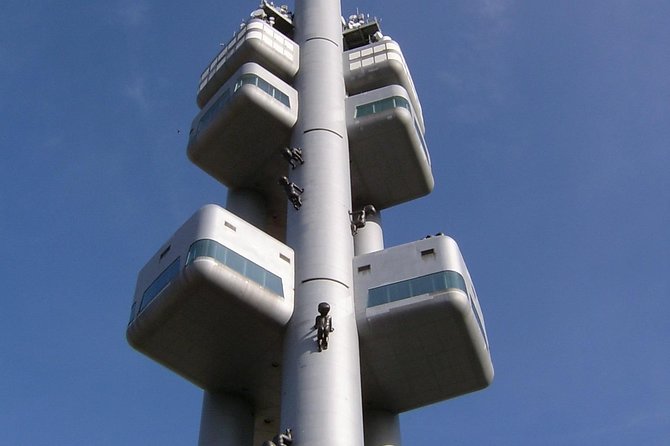
- Vitkov Hill views: Look across Prague’s Old Town toward the distinctive Zizkov Television Tower after the climb.
- Places tied to protest: Connect the John Lennon Wall, Wenceslas Square, the Prague Spring, and the Velvet Revolution.
- Private attention: Your group has its own historian guide, with Alzbeta and Vadim named among the guides associated with the experience.
- Practical choice: Tram tickets are included, but food, drinks, and hotel pickup are not.
Prague’s Cold War story begins below street level
This experience is not simply a walk past statues with dates attached. It asks you to look at Prague as a city shaped by fear, control, protest, and sudden political change.
The tour covers the communist period from 1948 to 1989. Your guide places daily life beside major events, explaining how a state controlled by the Soviet Union affected public speech, the press, military displays, and ordinary people. The strongest part of the experience is the link between physical places and political memory.
You meet in central Prague, near the Church of Saint Joseph at Náměstí Republiky, unless a different pickup has been arranged. Arrive 15 minutes early. From there, the route uses walking and public transport, with tram tickets included.
The advertised price is $390.37 per group. That is a serious bill for three hours, but it makes more sense if you fill the group. Split among six people, it comes to roughly $65 per person. The information also describes the rate as based on six people or fewer, while the headline allows up to 10, so confirm the exact group-price terms before paying if you have more than six in your party.
More recent history in Prague:
- Prague: Communism History and Nuclear Bunker Guided Tour
★ 4.7 · 2,417 reviews - Prague Communism History and Nuclear Bunker Tour
★ 5.0 · 1,742 reviews - Communism & Nuclear Bunker Tour + 70s Canteen Lunch (own expense)
★ 5.0 · 1,036 reviews
The Karlin-Zizkov tunnel and its locked shelter doors
The first stop is the pedestrian tunnel connecting Karlin and Zizkov. You spend about 10 minutes here, looking at locked doors leading toward nuclear bomb-shelter corridors built during the Cold War and still maintained.
You do not need a long stop for this place to make an impression. The doors are plain, even bleak, but that is the point. Cold War preparation was often hidden behind ordinary urban surfaces. The tunnel gives your guide a useful opening to explain the atmosphere of the period, when military threat was part of public life even when it was not visible on every street.
This is also a good example of why a private guide helps. Without context, you might walk past the doors and see only a locked entrance. With an explanation of their purpose, the tunnel becomes a reminder of how Prague prepared for a possible nuclear conflict.
There is no admission charge here. Expect a short outdoor stop rather than an underground bunker visit. The supplied details describe the shelter corridors and locked doors, not access inside them.
The climb to Vitkov Hill and the National Monument
The most substantial physical portion comes next. You climb Vitkov Hill for about 20 minutes to reach the National Monument. The route is steep, so wear sensible shoes and take this section seriously if you have mobility concerns.
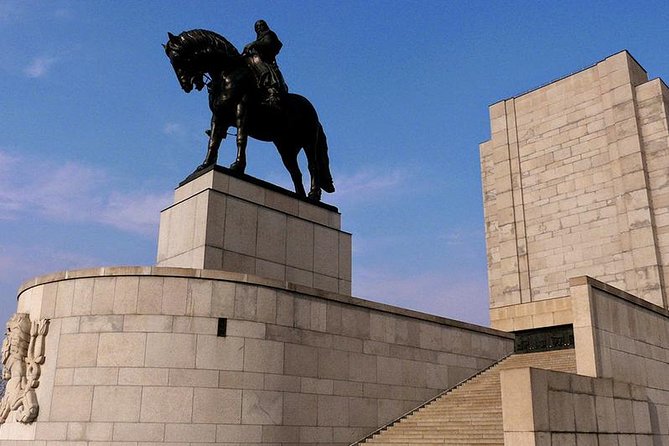
At the top, the monument combines several layers of Czech and Slovak history. It commemorates Czech and Slovak warriors of the First World War, but the Cold War focus comes through the Hall of the Soviet Soldier and the former mausoleum of Klement Gottwald.
Gottwald served as Czechoslovakia’s president from 1948 to 1953 and was also general secretary and chairman of the Communist Party. His body was once displayed here after his death, following the model of other communist regimes that used preserved leaders as symbols of political power.
The former mausoleum is the tour’s strangest and most memorable stop. You can look into the laboratory and temperature-control center where staff worked to maintain the embalmed body. This is not polished palace history. It is a behind-the-scenes look at the practical effort required to turn a political leader into a permanent public symbol.
The National Monument also contains the enormous bronze equestrian statue of Jan Zizka, described as the third-largest bronze equestrian statue in the world. The monument’s military scale helps you understand how public spaces can be used to shape national memory.
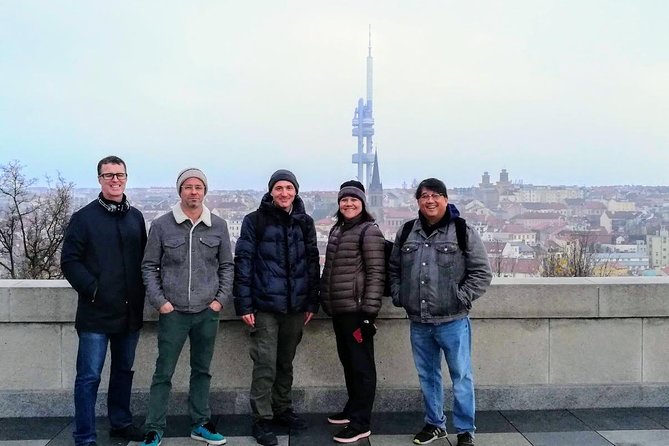
The hill itself rewards the effort. From the memorial, you get broad views toward Prague’s Old Town, with the Zizkov Television Tower visible on the horizon. One guide has also been praised for timing the stop around sunset, so an afternoon departure may offer especially attractive light. That timing is not guaranteed, but the choice of morning or afternoon gives you some control.
Admission to the National Monument is not included. The tour details also do not specify the current entrance arrangement or whether the interior rooms are always open, so ask for the exact access plan when booking.
The Zizkov Television Tower and Prague’s modern silhouette
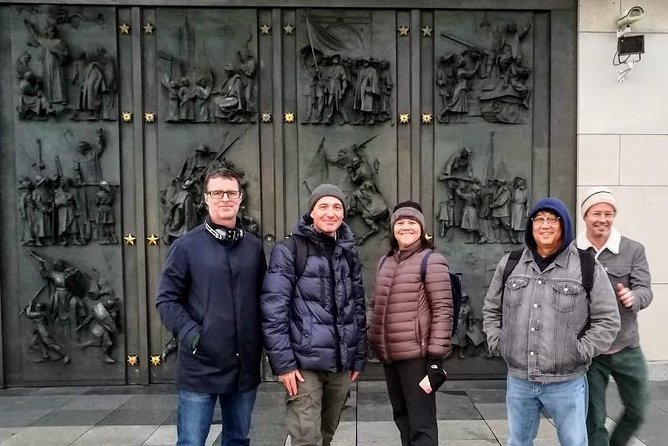
The next stop gives you a quick look at the Zizkov Television Tower. The listed time is about five minutes, so think of this as a viewing point and design discussion rather than a full tower visit.
The tower is a strong example of Prague’s Brutalist-era architecture. Its unusual form cuts across the older city skyline, and from Vitkov you can understand how sharply it contrasts with church spires and historic roofs.
This brief pause works because it adds visual variety. The tour is not only about documents and political speeches. It also shows how the communist period left its mark on Prague’s appearance.
Do not expect admission to the tower or an extended visit inside. The stop is free and centers on the best view of the building.
More walking routes in Prague:
- Prague: 3-Hour Walking Tour of Old Town & Prague Castle
★ 4.7 · 5,696 reviews - Prague: Ghost Walking Tour Where Legends Come To Life
★ 4.4 · 5,253 reviews - Prague: Jewish Quarter Walking Tour with Admission Tickets
★ 4.7 · 3,729 reviews - Prague Guided Walking Tour and Cruise with Authentic Czech Lunch
★ 5.0 · 3,627 reviews
Wenceslas Square, from military power to public protest
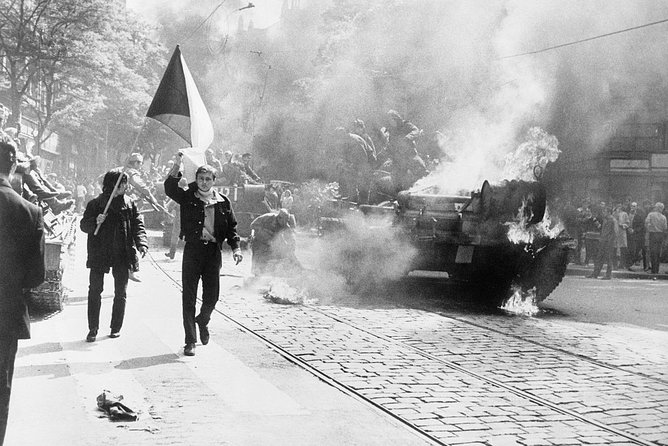
Wenceslas Square is the political heart of the route. You spend about 20 minutes walking through the square and tracing its long history, from its medieval origins to military parades, occupation, protest, and political celebration.
The key event here is the Prague Spring of 1968. For about eight months, attempts were made to allow greater freedom of speech and a more independent press. Warsaw Pact tanks entered Czechoslovakia and brought that period to an end. Your guide explains how the square became part of that confrontation and what the occupation meant for the country.
Then the story moves to 1989. Wenceslas Square filled with people during the demonstrations that helped bring down communist rule. The Velvet Revolution did not unfold in a distant government office. It took shape in public places where people gathered, spoke, and refused to remain silent.
I find this stop valuable because it ties large political terms to a place you can actually walk through. The Prague Spring and Velvet Revolution can sound abstract in a textbook. Here, you see the square where military force and mass protest played out.
The square is also easy to combine with the rest of your sightseeing in central Prague. Since the tour begins near Náměstí Republiky and ends in Prague without a fixed return point listed, you can ask your guide where the walk finishes and plan your next stop accordingly.
The John Lennon Wall and the language of dissent
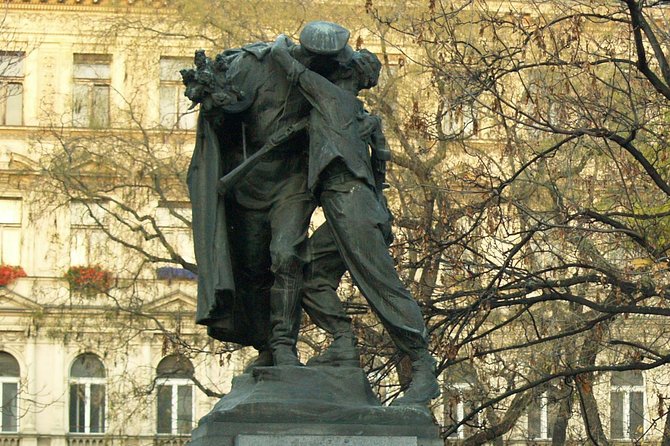
The John Lennon Wall represents a different kind of opposition. During the Cold War, people painted messages of hope, freedom, and protest on the wall, drawing on Western popular culture and the image of Lennon as a symbol of peace.
The wall is not a conventional memorial with one fixed message. Its meaning comes from the act of writing on it, especially when public expression was controlled. Graffiti turned an ordinary surface into a place where people could voice ideas that had little room elsewhere.
The overview places the John Lennon Wall among the main stops, though the detailed stop list emphasizes the tunnel, Vitkov Hill, Wenceslas Square, and the upside-down Wenceslas sculpture. Ask your guide to confirm the exact route on your chosen date.
This stop adds a human scale to the tour. Gottwald’s mausoleum shows official power from above. The Lennon Wall shows individual expression from below. Together, they give you two very different ways to understand the same period.
The upside-down Wenceslas and a final modern note
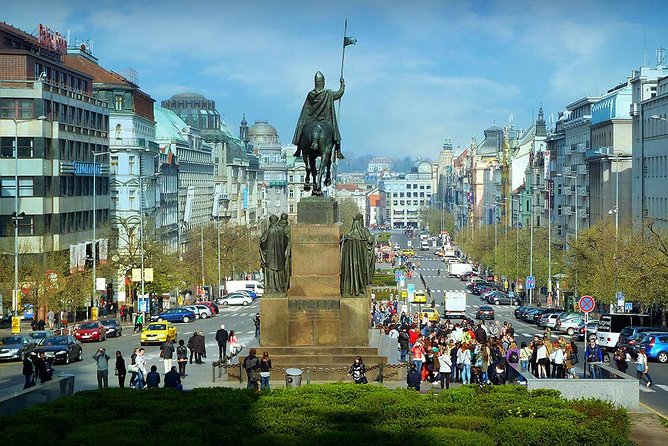
The route includes a five-minute stop at the upside-down statue of King Wenceslas riding a dead horse. This ironic sculpture offers a sharp change of mood after the military and political weight of the earlier stops.
The work invites you to think about how Central Europeans use humor and absurdity to question authority. You will not spend long here, but the stop gives your guide a chance to connect older national symbols with current political ideas.
Because the statue is compact and easy to view, this is a low-effort stop. It also makes a useful closing image: Prague’s political memory is not expressed only through solemn monuments. Satire has its place too.
What your guide adds to the experience
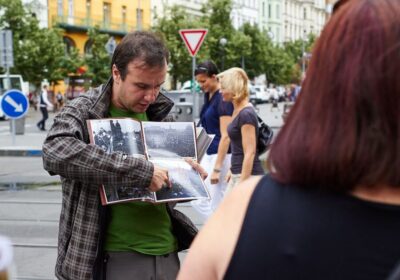
A private historian can change the pace and depth of this tour. The named guides include Alzbeta and Vadim. Alzbeta has been praised for linking buildings and events with family experiences, while Vadim is described as engaging groups by asking questions and relating the subjects to students.
Those details matter. A tour about communism can become a string of dates if the guide only talks at you. The better approach is to connect political changes with daily life and invite you to consider what freedom, censorship, and public fear meant for ordinary families.
Vadim has also provided restaurant and bar suggestions after tours. That is a useful bonus, especially because the walk ends in the city center and food is not included. You can ask your guide for recommendations, but treat them as personal suggestions rather than part of the formal tour.
The private setup means only your group takes part. That is valuable if you want to ask about a relative’s experience, compare Czech and other Eastern Bloc histories, or spend longer at one stop. It also means the cost is easier to justify with a family or group of friends than for one person alone.
Timing, fitness, and what to bring
You can choose a morning or afternoon departure. Morning is the safer choice if you want the rest of the day free, while afternoon may give you the chance to see Vitkov Hill near sunset. The sunset effect is possible, not promised, so do not book solely for that.
Plan on three hours, with a mix of walking, stairs or inclines, and tram travel. The steep Vitkov climb is the main physical challenge. If you have mobility issues, tell the operator in advance. The hill can be left out, allowing the guide to focus on other Cold War sites.
Wear shoes suited to a prolonged city walk. Bring water, since food and drinks are not included, and dress for changing weather. You will spend time outside at the tunnel, hill, square, and wall.
Hotel pickup and drop-off are not included unless separately arranged. The default meeting point is Kostel Svaty Josef at Náměstí Republiky 1077/2. Public transportation is nearby, and tram tickets are included in the tour price.
Free cancellation is available if you cancel at least 24 hours before the start time. Changes or cancellations made inside that window are not refunded, based on the stated policy.
Who should book this private Prague walk?
I would choose this tour if you want more than Prague’s medieval center and castle views. It suits you if the Prague Spring, the Velvet Revolution, Soviet influence, military memorials, and public protest are subjects you want to understand in place.
It is particularly useful for families, private groups, and study-abroad groups. The guide can adapt explanations and answer questions without a large group slowing the conversation. The tour also suits people who have read about communist Europe and want to test those ideas against actual sites.
I would think twice if you want a gentle walk with little political discussion. The Vitkov climb is real, the subject matter can be heavy, and the old mausoleum is unusual rather than conventionally beautiful. The tour also does not include meals or a general sweep of Prague’s famous sights.
Should you book the Cold War walking tour?
Book it if you want a focused look at Prague from 1948 to 1989 and value a private historian over a cheaper group tour. The combination of the bomb-shelter doors, Gottwald’s preservation rooms, Vitkov views, Wenceslas Square, the John Lennon Wall, and the upside-down Wenceslas gives the experience a strong range.
The best value comes when several people share the group price and take advantage of the guide’s flexibility. Confirm the exact group limit, National Monument access, John Lennon Wall routing, and pickup details before booking. If you can manage the hill, this is one of the more useful ways to connect Prague’s Cold War politics with the streets where those events unfolded.
FAQ
How long does the Prague Cold War walking tour last?
The tour lasts approximately three hours.
How much does the private tour cost?
The listed price is $390.37 per group. The information describes the price as based on six people or fewer, while the group capacity is also stated as up to 10, so confirm the applicable rate for groups larger than six.
What language is the tour offered in?
The tour is offered in English.
Where does the tour begin?
Unless hotel pickup has been arranged, meet at Kostel Svaty Josef, Náměstí Republiky 1077/2, Prague 1. You should arrive 15 minutes before the start time.
Are tram tickets included?
Yes. Tram tickets are included in the tour price.
Is hotel pickup included?
Hotel pickup and drop-off are not included unless they have been separately arranged.
Is the tour suitable for someone with mobility issues?
The tour includes a steep climb of about 20 minutes up Vitkov Hill. If you have mobility issues, contact the operator in advance because the hill can be omitted.
Can I cancel for a full refund?
Yes, if you cancel at least 24 hours before the experience begins. Cancellations or changes made less than 24 hours before the start time are not refunded.
Just added in Prague
- World War II 4WD Tour from Prague with Lunch★ 4.4 · 3 reviews
- WWII and Communism History in Prague’s Old Town Private Tour★ 5.0 · 4 reviews
- Prague: Historical Walking Tour with Focus on World War 2★ 4.3 · 12 reviews
- Walking tour of Prague in french: Old Town & Charles Bridge★ 4.9 · 62 reviews
- Unique salt cave in Prague★ 4.9 · 10 reviews
- Prague: Market Tour and Traditional Czech Cooking Class★ 4.7 · 19 reviews
- Ultimate Unlimited Beer Pong with Czech Beer★ 4.6 · 5 reviews
- Walking tour of Prague in French : Nové Město★ 4.9 · 16 reviews
Communism & WWII History Tours, compared.
Communism History and Nuclear Bunker Guided Tour
Read our review →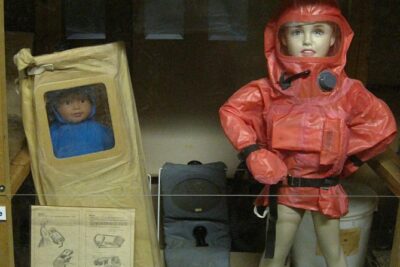
Prague Communism History and Nuclear Bunker Tour
Read our review →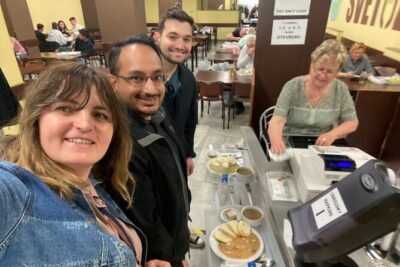
Communism & Nuclear Bunker Tour + 70s Canteen Lunch (own expense)
Read our review →
WWII Guided Tour & The Crypt of Operation Anthropoid
Read our review →
WWII in Prague Tour & The Crypt of Operation Anthropoid
Read our review →
Communism and Bunker Tour with 70s Canteen Lunch
Read our review →
Small-Group World War 2 & Operation Anthropoid Tour in Prague
Read our review →
World War 2 and Operation Anthropoid Walking Tour
Read our review →Browse the lists this tour appears in